A21 Floral Villas, Sai Kung becomes the official starting point of our journey. Ringo, our long suffering taxi driver over the years takes us to Hung Hom station at six in the morning. As we drive through Sai Kung for the last time in a long time we muse on what the place has come to mean to us. So much familiarity with it, everywhere we look there are countless fond memories associated with the view. It will be difficult if not impossible to replace how good Sai Kung has been to us over the past six and a half years.
Hung Hom station provides us with our last taste of Hong Kong in the form of a blueberry muffin and a tall Americano with skimmed milk. With the South China Morning Post tucked neatly under one arm for the news and crossword we board the Kowloon-Canton Railway for the two hour trip north to Guangzhou.
Guangzhou East Train Station proves to be the stepping off point into the deep end of China. I am totally unfamiliar with it as a location and the heavy bags make finding a ticket office a chore. Hacking, spitting, chain smoking middle aged Chinese men with paunches and brown suits shout loudly into their mobile phones, certain confirmation, if needed, that we are now across the border. Fortunately China does its usual thing and provides us with a string of amusing people with broken English who assist and entertain us on our way. The Guangzhou Metro is every bit as modern and efficient as Hong Kong’s MTR, a model of underground railway sophistication. Guangzhou Main Train Station however reminds us of the realities of travel in this vast country. What seems like an army of one hundreds thousand commuters mill around slurping spicy instant noodles from large paper bowls. A thick haze of stale cigarette smoke hangs in the air and yellow nicotine stains adorn the walls and ceilings, a testament to the amount of waiting that takes place here.
The K82 Sleeper Train departs at 14:34 on the dot and the next twenty-five hours roll past in a blur of sleep, scenery and green tea which we drink from our newly purchased plastic flasks that are the quintessential Chinese travel accessory.
First impressions of Xian confirm that it is a UNESCO world heritage site, the crenelated city walls peak above the swarm of tourists and touts that go hand in hand with anything given such an accolade. Like many places in China however the holiday makers are rarely foreign, the booming domestic tourism industry is quite clearly not suffering from the effects of a global recession.
A gentle evening stroll around the outside of the city walls reveals the citizens of Xian indulging in a bit of R’n’R as the sun goes down. A winding path threads its way through a narrow strip of public park abutting the walls. The very old, very young and everybody in between are grabbing a slice of the action. Couples promenade, teens swot ping pong balls energetically back and forth across purpose built outdoor tables, old gents stretch their limbs over the ubiquitous exercise equipment and a troupe of middle aged woman line dance like there is no tomorrow. A young girl sings her heart out at an alfresco karaoke bar and toddlers with squeaky shoes are encourage to say “Hello” to the passing ‘Lao Wai’ by doting parents. I remember again why I fell in love with China, where else in the world can you find such random pleasant oddness?
I am desperately seeking something in Xian that enables me to envision it as the eastern terminus of the silk road. I almost need to feel the pull of an unseen conduit drawing me west, away from the old Chinese capital. Wandering through the back streets of the Muslim quarter is pleasant but the large western style shopping malls packed with McDonald’s, KFC, Pizza Hut, Louis Vuitton and Nike stores as well as the grotesque tourist overload of the Drum Tower area leave me wondering what on earth this has got to do with where we are heading.
Leaving the crowds behind we hand over our money and begin the ascent up onto Xian’s infamous city walls, apparently some of the best preserved medieval city walls anywhere in the world. They do not disappoint. They are wide enough to drive a car along and high enough to put off any would be assailants. With the guard and gate towers built like fortified pagodas, so symbolic of Chinese architecture, it is one of those place that just conjures up images in your mind. For me it brings to mind one of my favourite films ‘Hero.' Zhang Yimou’s cinematic masterpiece of colour and emotion tells the fictionalised yet historical tale of the first emperor of China, Qin Shi Huang. The man who brought China’s various warring states together in 221BC through brutal conquest and united them in a capital not far from Xian. The costumes, sets and feel of this movie allow me to look upon the city with a certain amount of poetic license. The city within the walls today is clearly undergoing a revolution in town planning. All the newest buildings seem to have been constructed according to traditional design. Focussing on these and carefully ignoring the concrete carbuncles devoid of any architectural influence it is possible to let your imagination take over. In my minds eye I see a vast ocean of tiled roofs. The apex’s dropping down in beautiful concave arcs to the exaggerated upturned overhanging eaves. Erupting out of the multitude of markets, barracks and residences to stand proud against the horizon is the imaginary palace itself, quite literally the centre of “The Middle Kingdom. For a moment I hold this image in my head. The capital came and went from the Xian area before returning again later during the Tang dynasty, where in the eighth century it reached it’s zenith. Nowhere else at this moment in history is as cosmopolitan or dynamic as Xian, then known as Changan. Persians, Turks, Tibetans, Sogdians and South Asians mingle in the streets. Merchants and monks, soldiers and scholars, poets and prostitutes, beggars and businessmen, courtesans and conmen all rub shoulders in this melting pot of faith, ethnicity and social status. Looking outwards from the city walls it is harder to picture the past. The towering skyscrapers, numerous cranes and industrial smog are more difficult to ignore. Out there somewhere in the dusty recesses of history however roads snake out from the four major city gates north, south, east and west, each passing through the endless fields of agriculture that were required to sustain a city of 2 million souls. It is at the West Gate that I have the most profound connection. The realities of the past are almost certainly very different from the idea I have been forming in my head but if the Silk Road isn’t about romance then what’s the point of this journey?
Qin Shi Huang’s collection of toy soldiers just outside Xian beats anything I ever had as a kid. Seven thousand life size terracotta warriors including cavalry and chariots might seem excessive to some but in comparison to his real army, this one, prepared for his journey into the afterlife must have resembled nothing more than small platoon. Nevertheless this dramatic display of power only cements further what I have already come to realise. I have found the Xian I was searching for, the grand capital city of old that marked the beginning of the journey west for so many bails of silk and here, rather than Hong Kong, is the symbolic start to our travels.
Thursday, 22 July 2010


Saturday, 15 May 2010
Rough Itinerary
Hi all,
After a very frustrating, but enjoyable wait for visas in Hong Kong it looks like we will be back on the road again soon. As we enter the Peoples Republic of Censorship we will be unable to update this blog directly and facebook will also be off limits. We will hopefully recruit a willing volunteer to help us upload email updates to this blog for us instead. If you are keen to know where we might be in the next few months here is a rough itinerary of places and dates. It is not exact but should be close enough.
25th May - Xian
29th May - Jiayuguan
1st June - Dunhuang
4th June - Urumqi
8th June - Hotan
10th June - Yengisar
11th June - Kashgar
14th June - Into Kyrgyzstan
16th June - Osh
18th June - Bishkek
21st June - Karakol/Ala-Archa area
28th June - Into Uzbekistan
29th June - Tashkent
30th June - Samarkand
3rd July - Bukhara
6th July - Urgench
7th July - Nukus
8th July - Day trip to Moynaq and Aral Sea
9th July - Urgench
10th July - Khiva
16th July - Into Turkmenistan
17th July - Darvaza
18th July - Ashgabat
19th July - Mary/Merv
20th July - Into Iran
21st July - Mashad
23rd July - Tehran
24th July - Reyy
27th July - Yazd
29th July - Esfahan
1st August - Shiraz
4th August - Presepolis
7th August - Tehran
8th August - Qazvin
9th August - Alamut and Castles of the Assassins
11th August - Into Turkey
23rd August - Into Syria
31st August - Into Turkey... again.
2nd September - Istanbul
8th September - To Varna, Bulgaria... Europe.
1st October - Glasgow!
Thanks for reading, all the best.
Rich.
After a very frustrating, but enjoyable wait for visas in Hong Kong it looks like we will be back on the road again soon. As we enter the Peoples Republic of Censorship we will be unable to update this blog directly and facebook will also be off limits. We will hopefully recruit a willing volunteer to help us upload email updates to this blog for us instead. If you are keen to know where we might be in the next few months here is a rough itinerary of places and dates. It is not exact but should be close enough.
25th May - Xian
29th May - Jiayuguan
1st June - Dunhuang
4th June - Urumqi
8th June - Hotan
10th June - Yengisar
11th June - Kashgar
14th June - Into Kyrgyzstan
16th June - Osh
18th June - Bishkek
21st June - Karakol/Ala-Archa area
28th June - Into Uzbekistan
29th June - Tashkent
30th June - Samarkand
3rd July - Bukhara
6th July - Urgench
7th July - Nukus
8th July - Day trip to Moynaq and Aral Sea
9th July - Urgench
10th July - Khiva
16th July - Into Turkmenistan
17th July - Darvaza
18th July - Ashgabat
19th July - Mary/Merv
20th July - Into Iran
21st July - Mashad
23rd July - Tehran
24th July - Reyy
27th July - Yazd
29th July - Esfahan
1st August - Shiraz
4th August - Presepolis
7th August - Tehran
8th August - Qazvin
9th August - Alamut and Castles of the Assassins
11th August - Into Turkey
23rd August - Into Syria
31st August - Into Turkey... again.
2nd September - Istanbul
8th September - To Varna, Bulgaria... Europe.
1st October - Glasgow!
Thanks for reading, all the best.
Rich.
Monday, 29 March 2010
Belated Bangladesh
The below excerpt was started some time ago whilst we were still in Bangladesh. For no good reason I have been tardy in finishing it. Although I have been brought back safely to my comfort zone here in Nepal, I still want to put this post up as a reminder of our/my experiences there. It was an adventure unlike any I have ever experienced!
A few words on Bangladesh. Sitting in our cabin aboard the Rocket I finally have the time and peace and quiet to gather my thoughts. The gentle hum of the steamer as it heads up river may well put me to sleep before I finish writing, no matter. Rich has filled you in on many of the details of our crazy journey through this mad country as I have remained silent trying to come to terms with our surroundings. I have to say I am feeling rather shell shocked. This country is utterly bonkers! I have never felt such a vast range of emotions in such a short space of time and in quick succession to one another. I think the best way to describe the experience of the past 3 weeks is to liken it to that of being on a roller coaster.
I have been fond of the thrill of the ride since I was very little, in fact it would be fair to say I had no fear and was always front of the queue. As I have grown older, and become more aware of my own mortality, I have found the experience much more daunting. First is the anticipation, the heady mix of excitement and fear as you wait to board. Your heart beats faster and your pulse quickens, your palms start to sweat. Once strapped in, you check the over head harness once and then twice to make sure it has engaged securely with the catch. Slowly the train leaves the safety of the platform and you realise there is no going back. Ahead lies the first steep ascent of track, which is taken at a painfully slow speed, this allows you time to consider what you have done and what you are about to experience. As you reach the top of the climb your stomach is full to bursting with butterflies and your breathing is urgent and shallow, the carriage teeters on the edge of oblivion until you can almost take no more. Then without warning the carriage plummets, leaving your stomach behind and your body pinned to the seat as you twist and turn defying gravity as you go. Delighted to still be of this world, you have only moments to recognise this fact before the train speeds off again to whisk you upside down and loop the loop. A few more twists and turns and then finally a gentle amble along some timid track brings you back to the haven of the platform. The ride is over almost before it began. You disembark wobbly legged, fuzzy of head and perhaps slightly nauseous, but definitely glad to be back on solid ground.
Reading back through my diary entries for Bangladesh I am both amused and bemused by the range of moods and emotions I have felt. To be honest I feel like I have had an intense work out session and am now sitting head in hands on the bench trying to catch my breath. I have hated and loved this country, not quite in equal parts! I have been pushed to the very edge of my comfort zone, although this could yet still be tested…
We have met some wonderfully genuine people, and many not so. I can’t help but chuckle to myself at my naivety in thinking this country would be similar to our experience of India. Gone are the reassuring head wobbles and warm smiles, instead we are met wherever we go with intense staring that is less of a novelty and rather more disconcerting. As a closet feminist I have found the ‘equality’ in a largely Muslim country more than a little tiring, I wonder how the women here really feel about their ‘place’. I have often felt like sticking out my tongue or raising a finger at an enquiring gent who entreats Rich, the ‘Sir, sir’, and ignores my presence as that of a dumb mute. It has become difficult to remain polite at the near constant entreaties for our country and occupation. I have had to bite my tongue a fair few times as Rich is asked ‘…..and who is She?’ as a thumb gestures over a shoulder in my direction whilst I trot obediently behind my good husband. If I am not being stared at with confused disbelief that I should be allowed to accompany Rich on his travels, then I am being leered at as if I am touting myself in nothing but my knickers in a window in Amsterdam. I am actually very well covered and my shape is disguised beneath layers of loose fabric. I should have been expecting all of the above, as on our first night in Bangladesh whilst we checked in to the Hotel Cairo I was told that I was lucky. The reason for this apparently was that I should have managed to snare a younger gent, me being 33 years and Rich only 31. I nodded in agreement to communicate my humble and grateful understanding of this most unusual and unlikely situation.
At the risk of sounding patronising and cliche, the level of poverty and over population is quite breath taking. Daily we are clung on to by dirty but very cute young children, some expertly carrying younger siblings on their hips as a mother would. They know what they need to do to survive and they go about their task with heart breaking skill. The divide between the rich and poor here is a gaping ravine. We have taken to eating in the cosmopolitan area of Gulshan whilst in Dhaka. This is a sign of our weakness as our taste for for porotta and oily vegetable curry for breakfast, lunch and dinner has waned. Whilst we feast on pizza or burritos in a sterilized air conditioned capsule, outside the dust and dirt ridden babies scramble amongst the debris to scavenge whatever morsel they can. We eat beside Bangladesh’s slickly attired hip elite who catch up on the gossip with one another whilst expertly taking calls, texting and checking Facebook from their hand helds, just like any other youths in a cosmopolitan city. They leave the restaurant and make it to their flashy 4 x 4’s untouched and blinded to the tiny begging hands.
Often we are told that Bangladesh is a very poor country, either by a rickshaw driver or a fruit stall holder. This much is obvious. Although the streets are strewn with rubbish as there seems to be no official means of refuse collection, the Bangladeshis waste nothing. Every item is treasured and carefully mended or stripped of its reusable parts. Disposable is not a term they know here. The humble coconut provides a huge variety of needs. It is a drink, a snack, the husk is used to scrub bathing elephants, the fibre is used to stuff mattresses, make rope and floor mats with. I am sure it is used for more still.
During our travels in Asia we have witnessed the imbalance of ‘work’ ethic between male and female more than once. There always seems to be a large group of chaps gathered at a tea stall, or around a radio with a few beers, whilst the women tend the crops/house/children/washing... the list goes on. Bangladesh seems no exception, there are the usual collection of gents who while away the day drinking tea and scratching their crotches, but for the most part the working class seem to be working very hard indeed. This is never more apparent than with the rickshaw drivers, who even once they have fleeced you for more than the going rate, will shift our bums from one side of the city to another for little more than a few pennies. If you were to watch a satellite clip of Bangladesh I am sure it would resemble armies of ants, busily and skillfully going about their work, from dawn until well after dusk. Although the locals seem fiercely aware of the many difficulties and flawed systems in their land, they are keen to let you know how proud they are of it and to extend us their ‘famous’ Bangladesh hospitality.
Taking any form of public transport is terrifying and yet strangely exhilarating, especially when you make it to your destination in one piece. Having a driving license and good working knowledge of the highway code as we know it does not seem to be a requirement to allow you control of any vehicle. Expert command of the horn though is a must for survival. I am sure my hearing may have been permanently impaired. I am impressed though by the variety of tunes and ditties the horn can be, there must be a thriving market here for horn downloads, much like mobile phone ringtones. Lane traffic control does not exist, although there are markings on the road should anyone ever decide this may be a sensible avenue to explore.
So what else to say? I could go on, but I think you get the picture. It was a wild 3 weeks, I am not pretending I am glad we were there instead of exploring the pink, blue or gold cities of Rajasthan, but in hindsight it was definitely a character building experience. Even through the tears there were some awesome moments which I will treasure. Further exploiting the cliches, I really am thankful that I have choices that I do and hope I can take this with me.
A few words on Bangladesh. Sitting in our cabin aboard the Rocket I finally have the time and peace and quiet to gather my thoughts. The gentle hum of the steamer as it heads up river may well put me to sleep before I finish writing, no matter. Rich has filled you in on many of the details of our crazy journey through this mad country as I have remained silent trying to come to terms with our surroundings. I have to say I am feeling rather shell shocked. This country is utterly bonkers! I have never felt such a vast range of emotions in such a short space of time and in quick succession to one another. I think the best way to describe the experience of the past 3 weeks is to liken it to that of being on a roller coaster.
I have been fond of the thrill of the ride since I was very little, in fact it would be fair to say I had no fear and was always front of the queue. As I have grown older, and become more aware of my own mortality, I have found the experience much more daunting. First is the anticipation, the heady mix of excitement and fear as you wait to board. Your heart beats faster and your pulse quickens, your palms start to sweat. Once strapped in, you check the over head harness once and then twice to make sure it has engaged securely with the catch. Slowly the train leaves the safety of the platform and you realise there is no going back. Ahead lies the first steep ascent of track, which is taken at a painfully slow speed, this allows you time to consider what you have done and what you are about to experience. As you reach the top of the climb your stomach is full to bursting with butterflies and your breathing is urgent and shallow, the carriage teeters on the edge of oblivion until you can almost take no more. Then without warning the carriage plummets, leaving your stomach behind and your body pinned to the seat as you twist and turn defying gravity as you go. Delighted to still be of this world, you have only moments to recognise this fact before the train speeds off again to whisk you upside down and loop the loop. A few more twists and turns and then finally a gentle amble along some timid track brings you back to the haven of the platform. The ride is over almost before it began. You disembark wobbly legged, fuzzy of head and perhaps slightly nauseous, but definitely glad to be back on solid ground.
Reading back through my diary entries for Bangladesh I am both amused and bemused by the range of moods and emotions I have felt. To be honest I feel like I have had an intense work out session and am now sitting head in hands on the bench trying to catch my breath. I have hated and loved this country, not quite in equal parts! I have been pushed to the very edge of my comfort zone, although this could yet still be tested…
We have met some wonderfully genuine people, and many not so. I can’t help but chuckle to myself at my naivety in thinking this country would be similar to our experience of India. Gone are the reassuring head wobbles and warm smiles, instead we are met wherever we go with intense staring that is less of a novelty and rather more disconcerting. As a closet feminist I have found the ‘equality’ in a largely Muslim country more than a little tiring, I wonder how the women here really feel about their ‘place’. I have often felt like sticking out my tongue or raising a finger at an enquiring gent who entreats Rich, the ‘Sir, sir’, and ignores my presence as that of a dumb mute. It has become difficult to remain polite at the near constant entreaties for our country and occupation. I have had to bite my tongue a fair few times as Rich is asked ‘…..and who is She?’ as a thumb gestures over a shoulder in my direction whilst I trot obediently behind my good husband. If I am not being stared at with confused disbelief that I should be allowed to accompany Rich on his travels, then I am being leered at as if I am touting myself in nothing but my knickers in a window in Amsterdam. I am actually very well covered and my shape is disguised beneath layers of loose fabric. I should have been expecting all of the above, as on our first night in Bangladesh whilst we checked in to the Hotel Cairo I was told that I was lucky. The reason for this apparently was that I should have managed to snare a younger gent, me being 33 years and Rich only 31. I nodded in agreement to communicate my humble and grateful understanding of this most unusual and unlikely situation.
At the risk of sounding patronising and cliche, the level of poverty and over population is quite breath taking. Daily we are clung on to by dirty but very cute young children, some expertly carrying younger siblings on their hips as a mother would. They know what they need to do to survive and they go about their task with heart breaking skill. The divide between the rich and poor here is a gaping ravine. We have taken to eating in the cosmopolitan area of Gulshan whilst in Dhaka. This is a sign of our weakness as our taste for for porotta and oily vegetable curry for breakfast, lunch and dinner has waned. Whilst we feast on pizza or burritos in a sterilized air conditioned capsule, outside the dust and dirt ridden babies scramble amongst the debris to scavenge whatever morsel they can. We eat beside Bangladesh’s slickly attired hip elite who catch up on the gossip with one another whilst expertly taking calls, texting and checking Facebook from their hand helds, just like any other youths in a cosmopolitan city. They leave the restaurant and make it to their flashy 4 x 4’s untouched and blinded to the tiny begging hands.
Often we are told that Bangladesh is a very poor country, either by a rickshaw driver or a fruit stall holder. This much is obvious. Although the streets are strewn with rubbish as there seems to be no official means of refuse collection, the Bangladeshis waste nothing. Every item is treasured and carefully mended or stripped of its reusable parts. Disposable is not a term they know here. The humble coconut provides a huge variety of needs. It is a drink, a snack, the husk is used to scrub bathing elephants, the fibre is used to stuff mattresses, make rope and floor mats with. I am sure it is used for more still.
During our travels in Asia we have witnessed the imbalance of ‘work’ ethic between male and female more than once. There always seems to be a large group of chaps gathered at a tea stall, or around a radio with a few beers, whilst the women tend the crops/house/children/washing... the list goes on. Bangladesh seems no exception, there are the usual collection of gents who while away the day drinking tea and scratching their crotches, but for the most part the working class seem to be working very hard indeed. This is never more apparent than with the rickshaw drivers, who even once they have fleeced you for more than the going rate, will shift our bums from one side of the city to another for little more than a few pennies. If you were to watch a satellite clip of Bangladesh I am sure it would resemble armies of ants, busily and skillfully going about their work, from dawn until well after dusk. Although the locals seem fiercely aware of the many difficulties and flawed systems in their land, they are keen to let you know how proud they are of it and to extend us their ‘famous’ Bangladesh hospitality.
Taking any form of public transport is terrifying and yet strangely exhilarating, especially when you make it to your destination in one piece. Having a driving license and good working knowledge of the highway code as we know it does not seem to be a requirement to allow you control of any vehicle. Expert command of the horn though is a must for survival. I am sure my hearing may have been permanently impaired. I am impressed though by the variety of tunes and ditties the horn can be, there must be a thriving market here for horn downloads, much like mobile phone ringtones. Lane traffic control does not exist, although there are markings on the road should anyone ever decide this may be a sensible avenue to explore.
So what else to say? I could go on, but I think you get the picture. It was a wild 3 weeks, I am not pretending I am glad we were there instead of exploring the pink, blue or gold cities of Rajasthan, but in hindsight it was definitely a character building experience. Even through the tears there were some awesome moments which I will treasure. Further exploiting the cliches, I really am thankful that I have choices that I do and hope I can take this with me.
Thursday, 25 March 2010


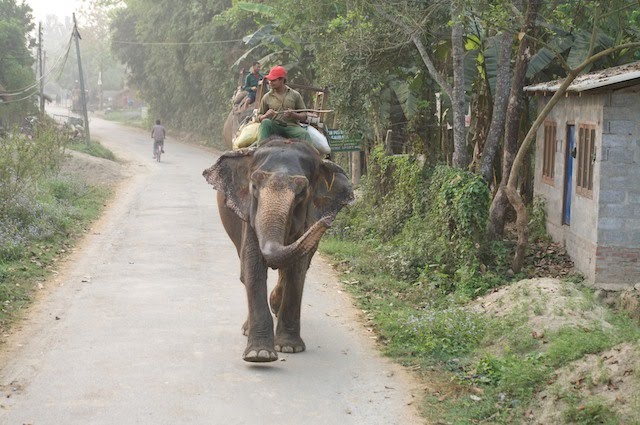


Royal Chitwan National Park
I have been remiss in not updating the blog of late. For this I blame my brother, who has joined us for a two week stint. In between catching up with him and indulging in Nepal's fine selection of food and beverages I have found little time to write anything.
Since leaving the double edged sword of luxury and cabin fever of Kathmandu behind we have been in Royal Chitwan National Park. I won't deny that the whole point of this was to see a Royal Bengal Tiger in the wild. We had seen them up close in Patan Zoo near Kathmandu but that, of course, is not the same. It wouldn't matter to us if it was only a fleeting glimpse in poor light at 500m distant, just to see one of these magnificent animals would have been a tick in the life long ambition book. In reality however you are more likely to see Rocking Horse poop in the park as you are a big striped cat. Our guides only see them 2-3 times a year and they are out pretty much 30 days a month, which works out as less than a 1% chance of seeing them. Not good odds when you only have 4 days.
The rewards of Chitwan however run much deeper than just reclusive pussy cats. Glorious dusty sunsets, peaceful Sal forests and an abundance of magnificent wildlife make this a remarkable place to spend time. On top of this comes the challenges of capturing this wildlife on camera. Very little of it hangs around long enough for you to fiddle with getting the correct shutter speed and aperture settings, couple this with shady forests interspersed with sun bleached grasslands and you have a very taxing process indeed relying on the constant adjustment of ISO and aperture to achieve the best quality image possible at very high shutter speeds. What a learning process however.
Despite very lucky sightings of some spectacular wildlife such as Great Hornbills, Bison, Gharial Crocodiles and Maribou Storks the most memorable moments were the ones where we 'almost' saw a Tiger. Guides would look thoughtfully at a paw print in the fine dust and then report authoritatively that it must have been here just 10 minutes previously... The best of all these however was the time we came across the fresh blood, still bright red and wet on the dew soaked grass of the early morning. Deer blood, we were informed, from a fresh kill being carried away for consumption in private. We followed the guide following the splashes of claret away from the safety of our jeep deeper into the 6 feet high Elephant grass where visibility shrank to the kind of distances a Tiger could cover quicker than you could shout "Oh bug...". Eventually the guide stopped and turned to me with a grave look on his face.
"If we follow, we will find." He said with totally certainty.
"but... very dangerous." He added with absolutely no trace of humour.
I did my best David Attenborough impression by trying to look knowledgeable and relaxed in such apparent close proximity to a man eater... time to get back to the jeep.
Another of the treats in store for us was the Vikram Baba festival we came across at a sacred site inside the forest. This annual event we were lucky enough to have coincide with our visit celebrates Vikram's Tiger hunt of years past. The story involves a Tiger turning white and Vikram's disappearance amongst a bunch of other stuff I couldn't quite get from our guides mumbled explanation. The end result however is a veritable army of the faithful converging on this one spot in the middle of the forest with their best goat in tow. Can you guess what happens next...?
Those who want children come here to request this of the gods and offer up payment for their prayers in the form of fresh blood, enter the goat from stage right...
Goat: "Baaaaa!"
Cleaver: "Thwaaaak"
Blood: "Squirt"
Headless Goat: "Flop"
Man with cleaver: "Next!"
...and so the process goes on and on and on. In the less than three minutes we stood there watching, four goats were despatched with the same kind of ceremony and sense of occasion that an office photocopier machine delivers on deadline day. Upon the Lingam (Post that resembles Shiva's phallus, the symbol of creation) the separate heads and bodies were tossed whilst they oozed and twitched their last, soaking everything around them in thick, sticky post box red gore.
Taking a metaphorical step back from what we have seen is a necessity. Barbaric or spiritual? To a tame westerner used to his food arriving safely wrapped in polystyrene and cellophane and looking nothing like the original cute and fluffy form, I find myself yet again, merely an observer unable to pass opinion or judgement.
I can say that, as an experience, it was pretty intense. Like rubber necking at an RTA that strange mix of revulsion and fascination complicates my perception of my own values and forces me to reflect. I'd also add that if you do eat meat then you should bear witness to the requirements of your choice at the very least, that is a given. Further to that thought, I find myself wanting to be the dice man. Not because I am attracted to the idea of killing, only that if I eat meat surely I should be prepared to do the killing myself? Delegating this task to someone else seems like the privileged way out of a coward.
These are some of the big questions that travel sometimes poses us. Nepal is without power for so much of the time I have stopped taking electric light at the flick of a switch for granted (almost). Tap water is not safe to drink, luckily bottled water is widely available but this still throws into stark relief the gratuitous waste and greed of the western world. We leave lights on when we don't need them and use drinking quality water for flushing our turds away! How far removed we are from the basic realities of life such as where our food comes from and how it reaches our table?
Perhaps I should buy a tie dyed t-shirt and get myself some dreadlocks... instead I think I'll order a steak and another Americano whilst I think on this further.
I actually have a series of photos of the goat butchering. Another ethical dilemma of whether I should have been photographing such a ceremony in the first place, sigh, is one I am putting off for later thought. At this stage however, for the sake of decency I have opted not to upload them.
In conclusion at this stage, Kurt Hahn's (educator and founder of Outward Bound) words ring true. "Indoctrination is of the devil but it is culpable neglect not to impel young people into value forming experiences." I have had such experiences and as such I am not going to offer you my opinion, instead I shall recommend experiences of your own. Then you are free to make up your own mind.
Since leaving the double edged sword of luxury and cabin fever of Kathmandu behind we have been in Royal Chitwan National Park. I won't deny that the whole point of this was to see a Royal Bengal Tiger in the wild. We had seen them up close in Patan Zoo near Kathmandu but that, of course, is not the same. It wouldn't matter to us if it was only a fleeting glimpse in poor light at 500m distant, just to see one of these magnificent animals would have been a tick in the life long ambition book. In reality however you are more likely to see Rocking Horse poop in the park as you are a big striped cat. Our guides only see them 2-3 times a year and they are out pretty much 30 days a month, which works out as less than a 1% chance of seeing them. Not good odds when you only have 4 days.
The rewards of Chitwan however run much deeper than just reclusive pussy cats. Glorious dusty sunsets, peaceful Sal forests and an abundance of magnificent wildlife make this a remarkable place to spend time. On top of this comes the challenges of capturing this wildlife on camera. Very little of it hangs around long enough for you to fiddle with getting the correct shutter speed and aperture settings, couple this with shady forests interspersed with sun bleached grasslands and you have a very taxing process indeed relying on the constant adjustment of ISO and aperture to achieve the best quality image possible at very high shutter speeds. What a learning process however.
Despite very lucky sightings of some spectacular wildlife such as Great Hornbills, Bison, Gharial Crocodiles and Maribou Storks the most memorable moments were the ones where we 'almost' saw a Tiger. Guides would look thoughtfully at a paw print in the fine dust and then report authoritatively that it must have been here just 10 minutes previously... The best of all these however was the time we came across the fresh blood, still bright red and wet on the dew soaked grass of the early morning. Deer blood, we were informed, from a fresh kill being carried away for consumption in private. We followed the guide following the splashes of claret away from the safety of our jeep deeper into the 6 feet high Elephant grass where visibility shrank to the kind of distances a Tiger could cover quicker than you could shout "Oh bug...". Eventually the guide stopped and turned to me with a grave look on his face.
"If we follow, we will find." He said with totally certainty.
"but... very dangerous." He added with absolutely no trace of humour.
I did my best David Attenborough impression by trying to look knowledgeable and relaxed in such apparent close proximity to a man eater... time to get back to the jeep.
Another of the treats in store for us was the Vikram Baba festival we came across at a sacred site inside the forest. This annual event we were lucky enough to have coincide with our visit celebrates Vikram's Tiger hunt of years past. The story involves a Tiger turning white and Vikram's disappearance amongst a bunch of other stuff I couldn't quite get from our guides mumbled explanation. The end result however is a veritable army of the faithful converging on this one spot in the middle of the forest with their best goat in tow. Can you guess what happens next...?
Those who want children come here to request this of the gods and offer up payment for their prayers in the form of fresh blood, enter the goat from stage right...
Goat: "Baaaaa!"
Cleaver: "Thwaaaak"
Blood: "Squirt"
Headless Goat: "Flop"
Man with cleaver: "Next!"
...and so the process goes on and on and on. In the less than three minutes we stood there watching, four goats were despatched with the same kind of ceremony and sense of occasion that an office photocopier machine delivers on deadline day. Upon the Lingam (Post that resembles Shiva's phallus, the symbol of creation) the separate heads and bodies were tossed whilst they oozed and twitched their last, soaking everything around them in thick, sticky post box red gore.
Taking a metaphorical step back from what we have seen is a necessity. Barbaric or spiritual? To a tame westerner used to his food arriving safely wrapped in polystyrene and cellophane and looking nothing like the original cute and fluffy form, I find myself yet again, merely an observer unable to pass opinion or judgement.
I can say that, as an experience, it was pretty intense. Like rubber necking at an RTA that strange mix of revulsion and fascination complicates my perception of my own values and forces me to reflect. I'd also add that if you do eat meat then you should bear witness to the requirements of your choice at the very least, that is a given. Further to that thought, I find myself wanting to be the dice man. Not because I am attracted to the idea of killing, only that if I eat meat surely I should be prepared to do the killing myself? Delegating this task to someone else seems like the privileged way out of a coward.
These are some of the big questions that travel sometimes poses us. Nepal is without power for so much of the time I have stopped taking electric light at the flick of a switch for granted (almost). Tap water is not safe to drink, luckily bottled water is widely available but this still throws into stark relief the gratuitous waste and greed of the western world. We leave lights on when we don't need them and use drinking quality water for flushing our turds away! How far removed we are from the basic realities of life such as where our food comes from and how it reaches our table?
Perhaps I should buy a tie dyed t-shirt and get myself some dreadlocks... instead I think I'll order a steak and another Americano whilst I think on this further.
I actually have a series of photos of the goat butchering. Another ethical dilemma of whether I should have been photographing such a ceremony in the first place, sigh, is one I am putting off for later thought. At this stage however, for the sake of decency I have opted not to upload them.
In conclusion at this stage, Kurt Hahn's (educator and founder of Outward Bound) words ring true. "Indoctrination is of the devil but it is culpable neglect not to impel young people into value forming experiences." I have had such experiences and as such I am not going to offer you my opinion, instead I shall recommend experiences of your own. Then you are free to make up your own mind.
Subscribe to:
Posts (Atom)